

There is that old saying that to a hammer, everything is a nail. It goes to follow that for a grief and communications specialist, one would see avenues of loneliness in places others might not. For example, when I watch a historical movie about a polar exploration, my thoughts run not to the excitement or danger of the quest but instead to the inherent solitude of the task. How did the crew bear being gone from humanity for so many months? I fear I end up missing the plot as I wonder how people bear the burden of their long isolation.
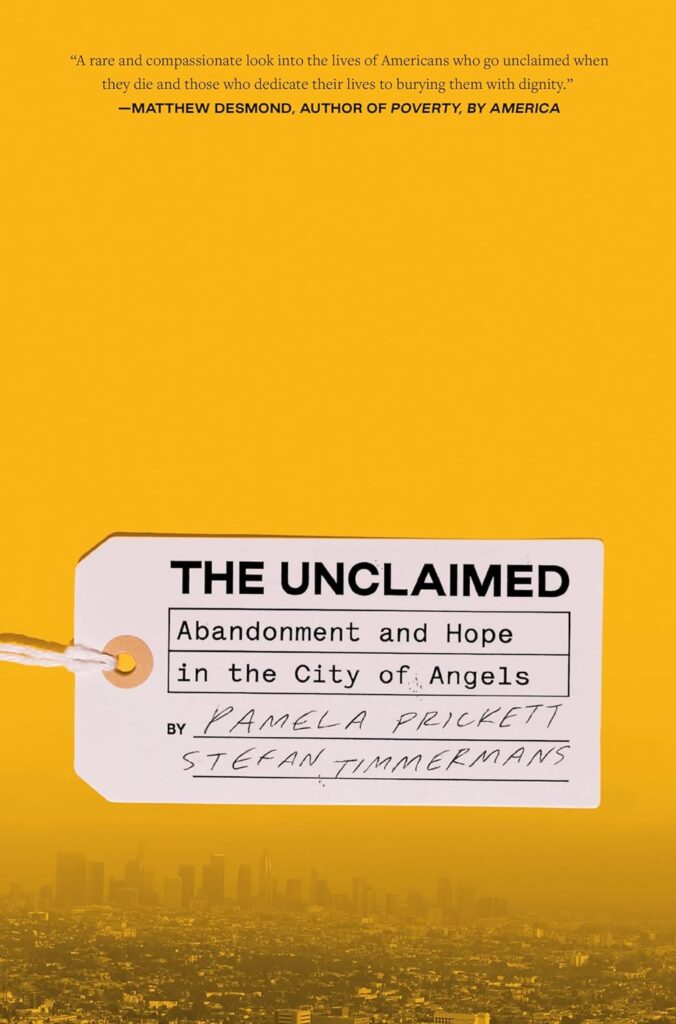
When I recently read the book The Unclaimed: Abandonment and Hope in the City of Angels by Pamela Prickett and Stefan Timmermans, one might have expected from the title alone that I might be pulled off course and into a morass of speculation regarding loneliness. I was still taken aback, however, as I was fully expecting a different sort of experience. The book proclaimed itself to be about what happens to dead bodies who are left at the county morgue. Morbid? Perhaps. I tend to enjoy forensic material, and the more unflinching the tale, the better. I settled in to relish a book that promised a recounting of indigent disposal after death. What I got was an invitation to examine how we deal with our connections and how many of us are not as far from being unclaimed as we’d like to think.
The word claim comes from the Latin clamare, which is to call out. This is an act of connection: when you make a claim, you are asserting a bond between yourself and something or someone else. This is the basis of the book, in which the authors explore the idea that to leave a body unclaimed is to be disconnected. Do these lives have no meaning? The book explores the lives of several people whose bodies eventually end up in the care of Los Angeles County, which has the largest burden of abandoned dead in the United States every year, as well as the people left to live in the aftermath and their various responses to dealing with the system. There are heroes, activists, heartbreak and not a few surprises to be found in the pages. While a casual reader may assume that a person ends up unclaimed due to drugs or mental illness, this book dispels that assumption and shows that it is not always the case. Indigent burials and unclaimed bodies are on the rise in our society. It is an unseen epidemic and it largely follows the rise of one that is plaguing the living: one of loneliness, fractured families, lost connections and broken communal ties.
While this book isn’t a fun, summer beach read, it certainly provides food for thought. Written in 2024, it is new enough to be relevant, yet it isn’t on any must-read lists and it doesn’t seem to have received widespread distribution. The authors clearly spent a great deal of time and care in the research and writing, and it paints a careful picture of our society, asking us to examine ourselves and who we want to be as a people going forward. Sir William Ewart Gladstone said, “Show me the manner in which a nation cares for its dead and I will measure with mathematical exactness the tender mercies of its people, their respect for the laws of the land, and their loyalty to high ideals.” It can’t help but be noted after reading this book that we are not the society we imagine ourselves to be. Can we still change? I believe we can. But the abandoned dead are a symptom of a far greater problem, one of which we are growing a terrible awareness, but like a child with a fear of a monster in under the bed, we don’t wish to face. We hide away and hope that the dread will dissipate come morning and the terror that stalked us will vanish. When, like children, will we learn that nothing will save us except our own action? We must stop pretending that there is no problem and face it squarely: that is the only remedy. In this case, the problem seems too much to handle and no one knows how to tackle it. But we can and we must try. We must unite to draw together and dispel loneliness when and where we are able. It is a fight, individually and on a societal level. It will take as much work and grit as anything we can muster. This may be the Great War of our time: not in guns and tanks on a far-off field, but in shaking off apathy and battling the desolation of shattered connections. It is our fight to make sure that our friends and neighbors, our mothers and children and we ourselves do not become unclaimed.