
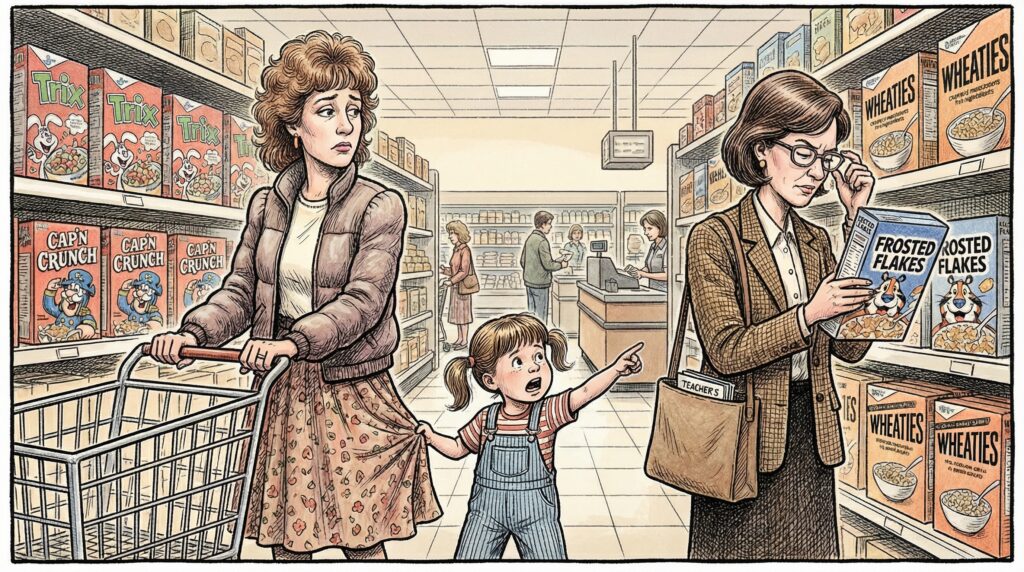

Our parents are exactly that: people who have raised us with some degree of success or another to adulthood. Merriam-Webster’s dictionary defines a parent as “one that begets or brings forth offspring,” followed immediately by “a person who brings up and cares for another,” and that seems to sum it up pretty neatly. I certainly didn’t see them as anything other than vehicles providing for my own well-being and necessity. This outlook wasn’t restricted to my parents and family elders but extended to all adults in my life. As a young child (but perhaps older than I’d like to admit) I still recall running into a teacher at the grocery store and being stunned at the incongruity of recognizance; at once I was met with the uncomfortable understanding that this person existed outside and independent of the sphere in which I had known her to belong to me and for me, alone. In the cereal aisle I was forced to confront the truth that she didn’t simply … occur … at school, waiting to educate me, some sort of erstwhile hologram who powered down in the meantime. Had I ever really thought that? Of course not. Yet watching her select the same cereal that I ate every morning was still a bit of a revelation: Ms. Jenkins1 was not only real, but had a life of her own that included preferences. It was an idea that somehow made me a bit uncomfortable, and my young self didn’t care to examine that discomfort.
Yet that discomfort, and those revelations, persisted, in less startling but more gradually dawning awareness as maturity prevailed over the years. Of course teachers and coaches have personal lives. Of course the mailman and librarian are adults and not just a function of their jobs. Of course our parents are people, too, and they existed before having children. Wait, that last one is a tough one. It’s easier to understand it as a concept than to accept it in reality.
That might sound absurd, but I really realized that for myself when my mom started getting much older. I had long since understood that she was a person, obviously, as I was well into motherhood myself. The problems came with my ability to empathize with her loneliness and subsequent depression. These things go together like peanut butter and jelly, and yet we tend not be able to recognize some of the warning signs, particularly since we may have the remnants of the idea from childhood that our parents are immune to this sort of thing. Restless sleep, a lack of appetite and being more withdrawn or spending more time at home are some of the top three signs that one of your parents, grandparents or an older loved one may be feeling lonely. It’s often difficult to distinguish these signs from other health problems, and it often seems counterintuitive to see a lonely person isolate themselves at home. Moreover, it sometimes feels as though another generation cannot possibly feel the sting of depression as keenly as we do. Somehow, it feels like our generation’s affliction, a curse for these modern times with our apps and our tech driving us apart. Are old people lonely? Sure, but haven’t they always been? It doesn’t seem any more or less of a problem then ever before.
Yet it is. There are more people over the age of sixty than have every lived before, and the bite of depression is as deep for the elderly as it is for any of us. Perhaps it is worse for those who no longer have the means to connect and whose social networks are shrinking every day.
This is not to say that there is no hope. There are many ways to help. The first is just to recognize the signs themselves. Simply asking how they are is a huge step. Asking once is one thing; asking a few times is a sure sign of care. Sustained care leads to hope, and loneliness cannot flourish under these conditions. Many people equate care with drudgery; they imagine changing sheets and washing dishes, but simply texting or phoning occasionally is usually enough to let someone know that they are loved.
Reaching out, asking, calling, texting or even a visit are all ways to show that you care. Take an interest in your friend or family and let them know that you are still in their life and they really aren’t alone. Sometimes they may feel that way, but showing them through action that that they matter is all it takes to help. It’s hard to get past that implicit bias that they are family first and people second, but seeing them clearly is the first step. Then everything begins with a conversation.
- Not her real name ↩︎